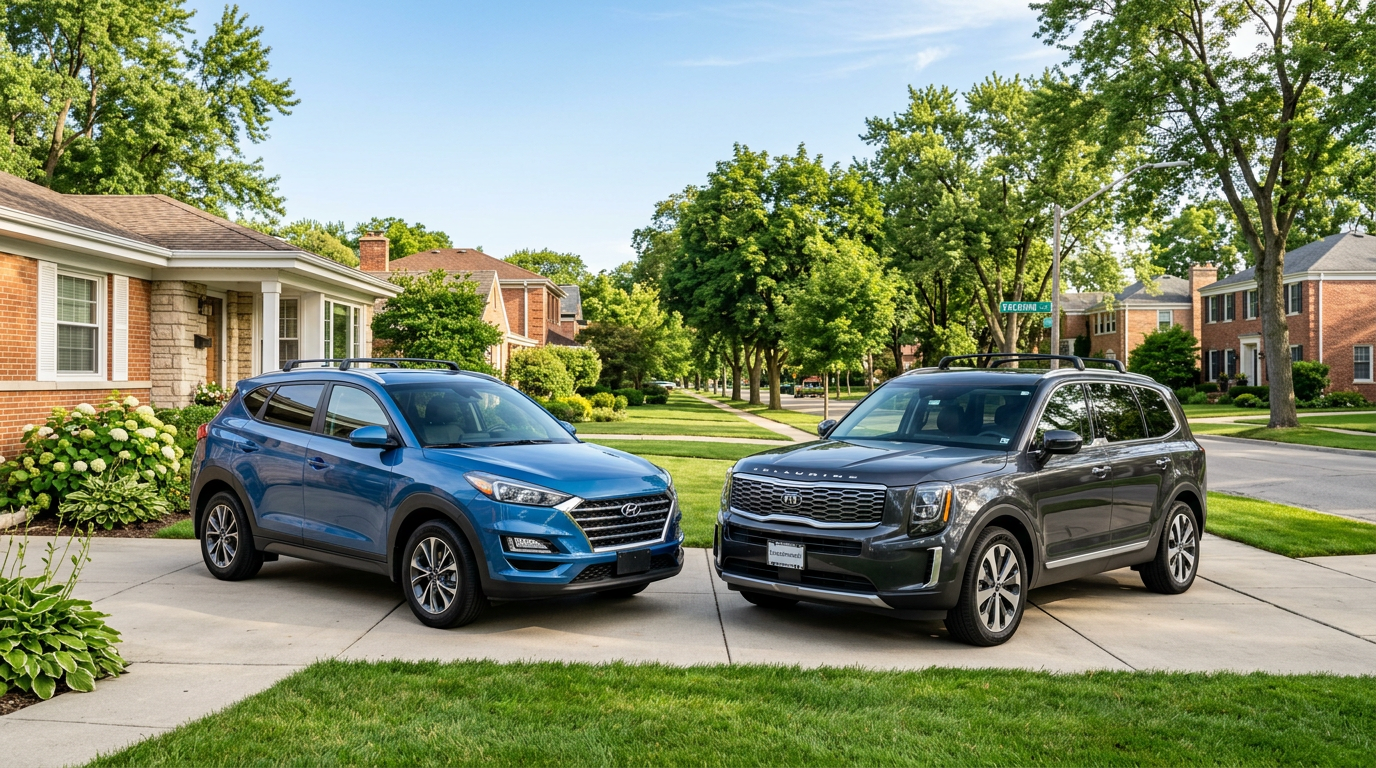
In the highly competitive compact and midsize SUV segments, choosing the right vehicle often comes down to comparing real-world capabilities side by side. Modern buyers expect their vehicles to handle daily commutes, accommodate growing families, and offer the latest safety technology without compromising on fuel economy. When shoppers visit our showroom at 6747 Lincoln Ave, Lincolnwood, IL 60712, they are typically looking for a vehicle that balances interior space, modern connectivity, and long-term value.
Evaluating these vehicles requires looking past basic marketing claims to analyze actual cabin dimensions, standard driver-assistance features, and powertrain options. A vehicle that looks spacious on paper might have restrictive cargo openings, while an SUV with high horsepower might suffer from a harsh ride or poor city fuel economy. By examining these details closely, you can identify which model truly fits your lifestyle and driving habits. If you want to check what we currently have on the showroom floor, you can give our team a quick call to speak with a product specialist.
Table of Contents
- Analyzing the Best Selling Models and Shifting Market Trends
- Comparing the Honda CR-V and Toyota RAV4 Against the Hyundai Tucson Hybrid
- Understanding the Engine Configurations Required for Maximum Tow Ratings
- Evaluating Resale Value and Premium Features in Compact Luxury SUVs
- Navigating Plug-In Hybrid Incentives and Clean Vehicle Tax Rules
- Common Questions About Shopped SUVs and Purchasing Options
- Finding Your Perfect Match at Hyundai Dealership
Analyzing the Best Selling Models and Shifting Market Trends
While national sales charts highlight massive volume for traditional trucks, the real battleground for local commuters is in the compact SUV segment. Recent automotive sales statistics demonstrate how quickly consumer preferences can shift based on vehicle availability and model updates. In the first quarter of 2026, the Honda CR-V climbed to the position of America's top-selling SUV, moving 99,437 units. During this same period, the Toyota RAV4 experienced a significant sales decline of 48.1%, dropping to 59,869 units as a result of a classic model changeover and supply constraints.
These shifting dynamics show that while a particular model may be a historical best-seller, production cycles and design updates heavily influence what is actually available for buyers to purchase. When a popular model faces supply shortages, smart shoppers expand their research to find comparable or superior alternatives that offer better immediate value. If you are ready to make a move on a highly sought-after model, you can begin the purchase path by getting approved for financing online to secure your terms before visiting the dealership.
Comparing the Honda CR-V and Toyota RAV4 Against the Hyundai Tucson Hybrid
Why do so many shoppers cross-shopping the top Japanese crossovers end up choosing a hybrid Hyundai instead? While the Honda CR-V is known for its smooth ride and the Toyota RAV4 offers a variety of specialized trims, the 2026 Hyundai Tucson Hybrid delivers a compelling combination of standard performance, interior volume, and advanced technology. For drivers navigating the dense, stop-and-go traffic along Devon Avenue in West Ridge, the hybrid powertrain's immediate electric torque and stellar city efficiency make daily driving incredibly relaxed.
The Tucson Hybrid comes standard with a 1.6L turbocharged hybrid engine producing 231 hp and 271 lb-ft of torque, paired with a smooth-shifting 6-speed automatic transmission and standard All-wheel drive. This setup avoids the loud, droning sensation often associated with the continuously variable transmissions (CVTs) found in rivals. In comparison, the standard gas-powered Tucson models feature a 2.5L inline 4-cylinder engine making 187 hp and 178 lb-ft of torque, mated to an 8-speed automatic transmission with Front-wheel drive.
The Tucson lineup offers versatile configurations to match different buyer needs:
- Blue SE: Starting at $32,450 MSRP, this entry-level hybrid trim features the 1.6L engine, 231 hp, All-wheel drive, and an EPA-rated 38 city / 38 hwy fuel economy.
- SEL Convenience: Priced at $34,900 MSRP, this trim adds premium comfort features while keeping the efficient 1.6L hybrid powertrain.
- SE: Starting at $29,450 MSRP, this gas-powered base trim utilizes the 2.5L engine and 8-speed automatic transmission.
- SEL: Listed at $30,800 MSRP, this gas trim adds key convenience features to the 2.5L powertrain.
- XRT: Priced at $33,475 MSRP, this rugged gas trim features unique exterior styling elements.
- Limited: Starting at $39,425 MSRP, this top-tier gas model includes luxury amenities, the 2.5L engine, and Front-wheel drive.
When you choose to visit your Chicago Hyundai dealer, you also gain the protection of the industry-leading Hyundai Assurance program, which includes America's Best Warranty. You can also view current Hyundai incentives to see how we make upgrading to a new SUV highly affordable. Should you ever need assistance, our state-of-the-art Hyundai service center is staffed by certified technicians who use only genuine parts to keep your vehicle performing at its peak.
Engine & Performance
Powertrain specs by trim
| Feature | Blue SE | Limited | SE | SEL | SEL Convenience | SEL Plus | SEL Premium | XRT |
|---|---|---|---|---|---|---|---|---|
| Engine | 1.6L | 2.5L | 2.5L | 2.5L | 1.6L | 2.5L | 2.5L | 2.5L |
| Horsepower | 231 hp | 187 hp | 187 hp | 187 hp | 231 hp | 187 hp | 187 hp | 187 hp |
| Torque | 271 lb-ft | 178 lb-ft | 178 lb-ft | 178 lb-ft | 271 lb-ft | 178 lb-ft | 178 lb-ft | 178 lb-ft |
| Transmission | 6-speed automatic | 8-speed automatic | 8-speed automatic | 8-speed automatic | 6-speed automatic | 8-speed automatic | 8-speed automatic | 8-speed automatic |
| Drivetrain | All-wheel drive | Front-wheel drive | Front-wheel drive | Front-wheel drive | All-wheel drive | Front-wheel drive | Front-wheel drive | Front-wheel drive |
Understanding the Engine Configurations Required for Maximum Tow Ratings
A frequent mistake SUV and truck buyers make is assuming that every trim level on the lot is rated for the maximum towing capacity shown in the commercials. In reality, achieving peak towing figures almost always requires selecting a specific engine, transmission, and towing package. For example, in the full-size truck segment, the Ford F-150 requires the 3.5-liter EcoBoost V6 engine to reach its maximum tow rating, while the Chevrolet Silverado 1500 requires either the 6.2-liter V8 or the 3.0-liter Duramax Turbo-Diesel engine.
This same principle applies to compact and midsize SUVs. The gas-powered 2026 Hyundai Tucson, equipped with the 2.5L engine, is rated to tow up to 2,750 lbs when properly equipped, which is a significant increase over prior model years. If you opt for the Tucson Hybrid with its 1.6L turbocharged engine, the maximum towing capacity is 2,000 lbs.
For families who need additional towing capability for small campers or recreational toys, stepping up in the Hyundai lineup is highly beneficial:
- The three-row 2026 Hyundai Santa Fe features a standard 2.5L turbocharged engine producing 277 hp and 311 lb-ft of torque, enabling a maximum tow rating of 3,500 lbs.
- The flagship 2026 Hyundai Palisade is powered by a robust 3.5L V6 engine making 287 hp and 260 lb-ft of torque, raising the maximum towing capacity to 5,000 lbs.
Evaluating Resale Value and Premium Features in Compact Luxury SUVs
Smart shoppers look past the initial badge appeal of luxury compact SUVs to calculate the true cost of ownership over time. While premium brands like Lexus consistently perform well in resale evaluations—with the Lexus NX retaining roughly 58% to 62% of its original value after three years—the high initial purchase price and expensive options packages can offset those gains. Mainstream SUVs in their highest trim levels often present a much smarter financial path by offering equivalent luxury features at a far more accessible price point.
Consider the 2026 Hyundai Tucson Limited trim, which starts at $39,425 MSRP with a $1,600 destination charge. This model comes fully loaded with premium features that typically cost thousands extra on a luxury brand, such as a panoramic sunroof, heated and ventilated leather seats, and a premium audio system. Additionally, you get advanced connectivity through Hyundai Bluelink+ features, which offer complimentary remote start, cabin pre-heating or cooling, and digital key sharing without any ongoing subscription fees. By choosing a top-tier mainstream model over an entry-level luxury badge, you avoid steep initial depreciation while enjoying a vehicle that is fully equipped with modern technology.
Pricing
Pricing by trim
| Feature | Blue SE | Limited | SE | SEL | SEL Convenience | SEL Plus | SEL Premium | XRT |
|---|---|---|---|---|---|---|---|---|
| Base MSRP | $32,450 | $39,425 | $29,450 | $30,800 | $34,900 | $31,300 | $33,800 | $33,475 |
| Destination charge | $1,600 | $1,600 | $1,600 | $1,600 | $1,600 | $1,600 | $1,600 | $1,600 |
Navigating Plug-In Hybrid Incentives and Clean Vehicle Tax Rules
There is a lot of outdated information online regarding clean vehicle tax incentives, and we want to ensure our guests have the absolute latest facts. Under federal law, the clean vehicle tax credits—including the IRC §30D credit for new vehicles, the §25E credit for pre-owned vehicles, and the §45W credit for commercial vehicles—were terminated for any vehicle acquired after September 30, 2025. This means that buyers purchasing a new plug-in hybrid (PHEV) or electric vehicle today do not qualify for these federal tax write-offs.
The only exception to this rule applies to buyers who took possession of a vehicle that was acquired on or before September 30, 2025, under a binding written contract with a deposit or trade-in already placed. If you fall into this narrow category, we recommend consulting with your tax preparer and our sales team to verify your eligibility. Fortunately, state-level incentives and manufacturer-backed promotions remain highly active, and our finance team is always available to help you find every available rebate to maximize your savings.
Common Questions About Shopped SUVs and Purchasing Options
Before making a final decision on your next SUV, it helps to clear up some of the most common questions our product specialists hear on the showroom floor.
Q: What coverage is included with the Hyundai factory warranty?
Every new Hyundai is backed by America's Best Warranty, which features a 10-year/100,000-mile powertrain limited warranty and a 5-year/60,000-mile new vehicle limited warranty. Owners also receive 24/7 roadside assistance for the first five years with no mileage limit, which you can access anytime by calling Hyundai Roadside Assistance: 1-800-243-7766. To explore how this comprehensive coverage protects your vehicle on every journey, you can learn about roadside assistance benefits online.
Q: How does Hyundai's complimentary maintenance program work?
New Hyundai models include complimentary factory-scheduled maintenance for the first 3 years/36,000 miles. This program covers standard oil changes, oil filter replacements, and tire rotations performed by our factory-trained technicians. To see how this program helps keep your vehicle in peak condition while lowering your overall cost of ownership, you can learn about complimentary maintenance eligibility before you buy.
Q: What is the Berman Hyundai Perfect Car Promise?
We want you to love what you drive, which is why we offer a specialized satisfaction guarantee on our vehicles. If you decide within a specific timeframe that your newly purchased vehicle is not the right fit for your lifestyle, our exchange policy allows you to bring it back and transition into a different model. You can learn about our Perfect Car Promise to shop our inventory with complete confidence.
Q: What digital tools are available to help manage my vehicle's health?
Every new Hyundai offers access to convenient digital ownership tools that allow you to track your vehicle's health, receive diagnostic alerts, and manage service intervals directly from your smartphone. To see how these connected services make vehicle ownership simple and stress-free, you can learn about Car Care features and digital resources before your first visit.
Q: Does the 2026 Hyundai Tucson Hybrid require a plug to charge?
No, the Tucson Hybrid does not require an external charging source. The vehicle utilizes regenerative braking and the onboard gas engine to charge its hybrid battery automatically while you drive. This setup allows you to enjoy the benefits of electric assistance and outstanding fuel economy without changing your daily driving or refueling habits.
Finding Your Perfect Match at Hyundai Dealership
When you are ready to transition from online research to the driver's seat, scheduling back-to-back test drives on the same day is the single best way to compare models while your impressions are fresh. Evaluating different SUVs on the same afternoon allows you to make direct comparisons regarding seat comfort, visibility, steering feel, and cabin noise. For buyers in Lincolnwood, we recommend a test-drive route that combines the stop-and-go traffic of Cicero Avenue with the high-speed acceleration lanes of the Edens Expressway to truly evaluate how each SUV handles local driving conditions.
Our team is dedicated to providing a transparent, no-pressure shopping environment to help you find the ideal vehicle for your family. If you have questions about our current inventory or want to schedule your visit, please contact our dealership today or reach out through our online contact form. You can easily find directions to our dealership or view our location on Google Maps to plan your trip. To speak directly with a sales consultant right now, give us a quick call and we will be happy to assist you.
© 2026 Berman Hyundai. All rights reserved.