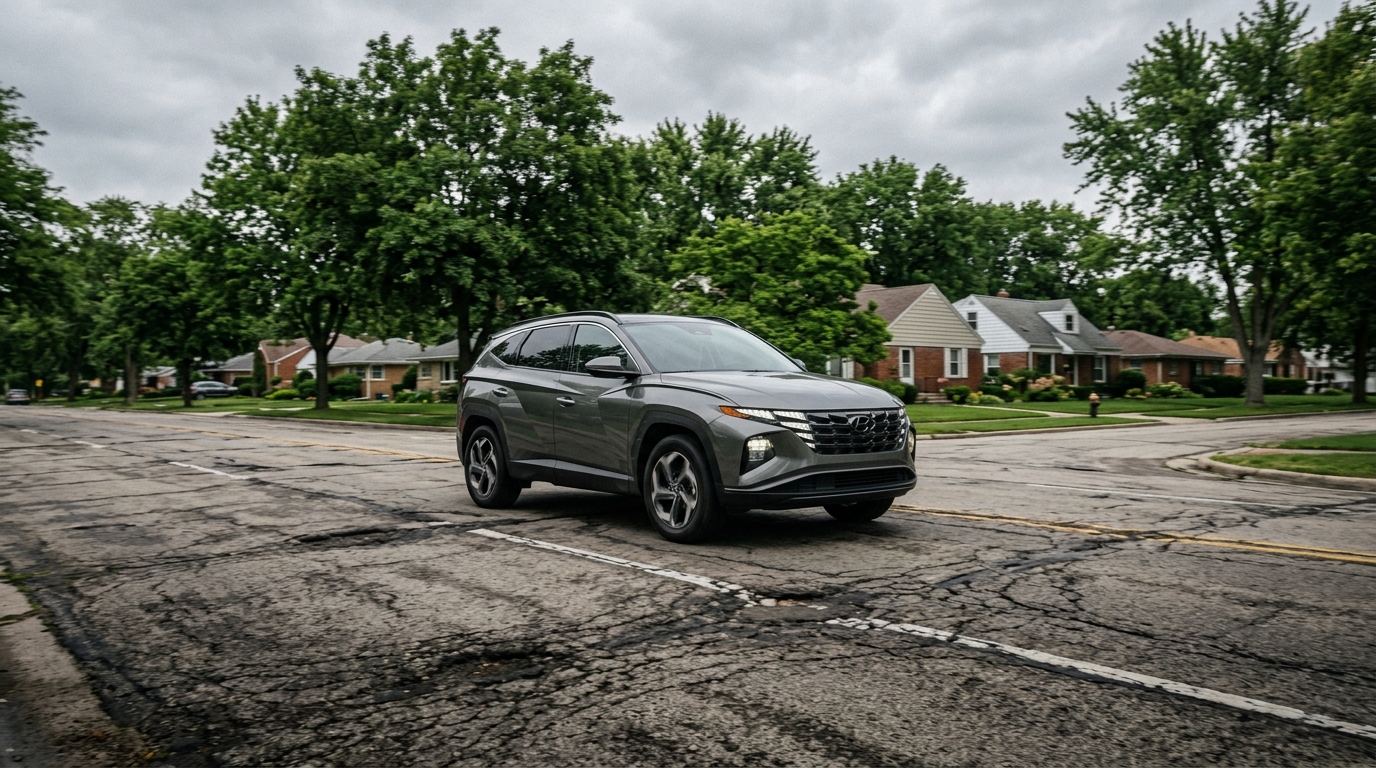
Hyundai Lane Following Assist provides limited or no steering intervention when road lines are faded, worn, or poorly painted because its forward-facing optical camera requires clear visual contrast to detect lane boundaries. When painted lines disappear, the system cannot lock onto lane edges and automatically disengages, requiring full manual driver control. In select situations, it may briefly use a lead vehicle's trajectory as a reference, but it cannot guarantee continuous lane-centering on poorly marked asphalt.
The technology behind Lane Following Assist relies on a high-resolution camera mounted near the top center of the windshield behind the rearview mirror. This camera continually scans the road surface ahead, reading painted contrast lines to calculate the vehicle's position within the lane. When lane markings are crisp and bright, the system applies continuous, subtle steering torque to keep the vehicle centered. However, when road surfaces suffer from severe wear, weathered paint, or accumulated road debris, the camera loses the clear visual signals required to compute steering adjustments.
Driver safety remains the primary foundation of this driver-support feature. It is engineered as an active comfort assistant rather than an autonomous driving system. When visual detection falls below operational thresholds, the system safely hands complete steering responsibility back to the driver. Whether navigating local suburban streets near our Lincolnwood showroom location or traveling on high-speed expressways, drivers must maintain active attention and keep their hands on the wheel. If you have questions about how active safety systems function on your vehicle, our team is always available at (847) 582-3294 to walk you through system settings and cluster indicators.
Table of Contents
- Why Do Faded Road Lines Reduce Lane-Assist Camera Performance?
- How Does Lane Following Assist Differ From Lane Keeping Assist?
- Should You Keep Lane Following Assist Active When Lane Lines Are Barely Visible?
- Is Paying More for an Advanced ADAS Driver-Assist Package Worth It?
- How Much Does Camera Recalibration Cost After a Windshield Replacement?
- Common Owner Questions About Hyundai Lane Following Assist Performance
Why Do Faded Road Lines Reduce Lane-Assist Camera Performance?
Faded road lines reduce lane-assist camera performance because optical sensors rely on distinct visual contrast between dark asphalt and light painted markings to detect lane edges. When paint wears thin from heavy traffic, sun exposure, or road salt, the image processing algorithm cannot identify clear boundary coordinates to calculate continuous steering corrections.
The forward-facing camera evaluates pixel brightness and geometric patterns to establish where the lane begins and ends. When road lines are worn down to patchy streaks, the optical contrast drops below the minimum detection threshold programmed into the safety module. Beyond physical paint degradation, several environmental factors compound visual detection challenges:
- Winter road salt residue and chemical brine that dull asphalt contrast during daily winter commutes to Chicago.
- Low sun angles creating intense glare directly on damp or wet pavement.
- Heavy rain, slush, or standing water reflecting light and obscuring painted lines.
- Temporary construction markings, tar strips, or pavement seams that confuse camera algorithms.
Drivers test-driving the 2026 Hyundai Tucson XRT across mixed road surfaces often ask how quickly the system alerts you when lane paint disappears. When the camera loses track of boundary lines, the instrument cluster provides immediate visual feedback. The steering wheel icon changes from green to gray or blinks white, signaling that steering assistance has paused. If you are cross-shopping models with standard active safety features, you can get approved for financing online before taking a test drive to evaluate driver-assist performance in person.
Engine & Performance
Powertrain specs by trim
| Feature | Blue SE HEV AWD | Blue SE HEV AWD (Before May 2026) | Limited AWD | Limited AWD (Before April 2026) | Limited FWD | Limited FWD (Before April 2026) | Limited HEV AWD | Limited HEV AWD (Before May 2026) | Limited PHEV AWD | Limited PHEV AWD (Before May 2026) | Night HEV AWD | SE AWD | SE AWD (Before April 2026) | SE FWD | SE FWD (Before April 2026) | SE HEV FWD | SEL AWD | SEL AWD (Before April 2026) | SEL Convenience HEV AWD | SEL Convenience HEV AWD (Before May 2026) | SEL FWD | SEL FWD (Before April 2026) | SEL HEV AWD | SEL HEV AWD (Before May 2026) | SEL HEV FWD | SEL PHEV AWD | SEL PHEV AWD (Before May 2026) | SEL Plus AWD | SEL Plus FWD | SEL Premium AWD | SEL Premium AWD (Before April 2026) | SEL Premium FWD | SEL Premium FWD (Before April 2026) | XRT AWD | XRT AWD (Before April 2026) | XRT FWD | XRT FWD (Before April 2026) |
|---|---|---|---|---|---|---|---|---|---|---|---|---|---|---|---|---|---|---|---|---|---|---|---|---|---|---|---|---|---|---|---|---|---|---|---|---|---|
| Engine | 1.6L | 1.6L | 2.5L | 2.5L | 2.5L | 2.5L | 1.6L | 1.6L | 1.6L | 1.6L | 1.6L | 2.5L | 2.5L | 2.5L | 2.5L | 1.6L | 2.5L | 2.5L | 1.6L | 1.6L | 2.5L | 2.5L | 1.6L | 1.6L | 1.6L | 1.6L | 1.6L | 2.5L | 2.5L | 2.5L | 2.5L | 2.5L | 2.5L | 2.5L | 2.5L | 2.5L | 2.5L |
| Horsepower | 231 hp | 231 hp | 187 hp | 187 hp | 187 hp | 187 hp | 231 hp | 231 hp | 268 hp | 268 hp | 231 hp | 187 hp | 187 hp | 187 hp | 187 hp | 231 hp | 187 hp | 187 hp | 231 hp | 231 hp | 187 hp | 187 hp | 231 hp | 231 hp | 231 hp | 268 hp | 268 hp | 187 hp | 187 hp | 187 hp | 187 hp | 187 hp | 187 hp | 187 hp | 187 hp | 187 hp | 187 hp |
| Torque | 271 lb-ft | 271 lb-ft | 178 lb-ft | 178 lb-ft | 178 lb-ft | 178 lb-ft | 271 lb-ft | 271 lb-ft | 271 lb-ft | 271 lb-ft | 271 lb-ft | 178 lb-ft | 178 lb-ft | 178 lb-ft | 178 lb-ft | 271 lb-ft | 178 lb-ft | 178 lb-ft | 271 lb-ft | 271 lb-ft | 178 lb-ft | 178 lb-ft | 271 lb-ft | 271 lb-ft | 271 lb-ft | 271 lb-ft | 271 lb-ft | 178 lb-ft | 178 lb-ft | 178 lb-ft | 178 lb-ft | 178 lb-ft | 178 lb-ft | 178 lb-ft | 178 lb-ft | 178 lb-ft | 178 lb-ft |
| Transmission | SHIFTRONIC® | SHIFTRONIC® | SHIFTRONIC® | SHIFTRONIC® | SHIFTRONIC® | SHIFTRONIC® | SHIFTRONIC® | SHIFTRONIC® | SHIFTRONIC® | SHIFTRONIC® | SHIFTRONIC® | SHIFTRONIC® | SHIFTRONIC® | SHIFTRONIC® | SHIFTRONIC® | SHIFTRONIC® | SHIFTRONIC® | SHIFTRONIC® | SHIFTRONIC® | SHIFTRONIC® | SHIFTRONIC® | SHIFTRONIC® | SHIFTRONIC® | SHIFTRONIC® | SHIFTRONIC® | SHIFTRONIC® | SHIFTRONIC® | SHIFTRONIC® | SHIFTRONIC® | SHIFTRONIC® | SHIFTRONIC® | SHIFTRONIC® | SHIFTRONIC® | SHIFTRONIC® | SHIFTRONIC® | SHIFTRONIC® | SHIFTRONIC® |
| Drivetrain | All-wheel drive | All-wheel drive | All-wheel drive | All-wheel drive | Front-wheel drive | Front-wheel drive | All-wheel drive | All-wheel drive | All-wheel drive | All-wheel drive | All-wheel drive | All-wheel drive | All-wheel drive | Front-wheel drive | Front-wheel drive | Front-wheel drive | All-wheel drive | All-wheel drive | All-wheel drive | All-wheel drive | Front-wheel drive | Front-wheel drive | All-wheel drive | All-wheel drive | Front-wheel drive | All-wheel drive | All-wheel drive | All-wheel drive | Front-wheel drive | All-wheel drive | All-wheel drive | Front-wheel drive | Front-wheel drive | All-wheel drive | All-wheel drive | Front-wheel drive | Front-wheel drive |
How Does Lane Following Assist Differ From Lane Keeping Assist?
Lane Following Assist continuously centers the vehicle in the middle of its lane using active, ongoing steering adjustments, whereas Lane Keeping Assist is a reactive safety system that only intervenes when the vehicle begins drifting across a detected lane boundary without a turn signal.
Understanding the operational differences between these two safety systems clarifies how Hyundai models help keep your family protected during daily travel:
- Lane Keeping Assist (LKA): Operating primarily at speeds above 40 mph, LKA acts as a safety net. It monitors lane edges and provides a haptic warning, visual indicator, or gentle steering nudge only when the vehicle approaches or steps over a lane line.
- Lane Following Assist (LFA): Operating from a complete stop up to highway speeds, LFA works proactively. It uses active steering inputs to hold the vehicle precise to the lane center, making it ideal for reducing driver fatigue in heavy traffic.
Vehicles like the 2026 Hyundai Elantra Limited pair a fuel-efficient 1.6L engine and EcoShift dual-clutch transmission—delivering an EPA-estimated 51 city / 58 hwy mpg—with both safety features standard. This combination allows drivers to experience continuous lane-centering on clear highways while keeping reactive drift protection active at all times. To see how these driver-assist technologies operate together on the road, get directions to our dealership and speak with our knowledgeable sales staff.
Should You Keep Lane Following Assist Active When Lane Lines Are Barely Visible?
You can safely leave Lane Following Assist active when road markings are barely visible because the system automatically transitions into standby mode without sudden mechanical feedback when lane detection is lost. However, drivers must remain fully engaged, as manual steering control returns entirely to the driver the moment visual tracking drops off.
Driving through urban neighborhoods like West Ridge often involves shifting pavement conditions, utility cutouts, and worn lane markings. When driving on roads where painted lines are faint, keeping the feature switched on does not harm the vehicle or steering system. If lane markings clear up farther down the road, the camera will automatically lock back onto valid lines and resume steering assistance without requiring manual reactivation.
While the system is in standby, drivers should be aware of key operational habits:
- Do not rely on automatic steering input when lane lines are intermittent or absent.
- Expect the system to transition smoothly between active centering (green icon) and standby (gray icon).
- Maintain a firm grip on the steering wheel, as hands-off detection sensors will issue warnings if driver input is not detected.
- Rely on manual steering around sharp curves, as camera tracking can drop when turn radii become tight.
If you ever feel uncertain about system indicators or safety settings on your vehicle, feel free to contact our dealership today to consult with our factory-trained advisors.
Is Paying More for an Advanced ADAS Driver-Assist Package Worth It?
Investing in a higher trim or advanced driver-assistance package is worth the added cost for buyers who spend significant time on congested highways or long family road trips, as advanced suites combine radar, camera, and navigation data to maintain vehicle control even when single camera inputs face limitations.
While entry-level camera setups provide essential safety coverage, upgraded suites like Highway Driving Assist II add side radar sensors, lane-change assist capabilities, and machine-learning steering responses. These advanced systems offer clear advantages across varied driving scenarios:
- Enhanced curve control using navigation route data to adjust speed before entering tight bends.
- Blind-spot steering intervention that active camera-only lane systems cannot provide.
- Smoother distance holding and lane adjustments during stop-and-go highway traffic.
- Integrated camera wash systems or sensor heating elements that maintain visibility in cold weather.
For example, the 2026 Hyundai Santa Fe Limited features a robust 2.5L engine producing 277 hp and 311 lb-ft of torque paired with a SHIFTRONIC transmission and standard Front-wheel drive, achieving an EPA-estimated 20 city / 29 hwy mpg. Its comprehensive safety technology suite delivers reassuring driver support for busy suburban family lifestyles. If you want to compare trim levels and safety packages to find a smart choice for your budget, reach out to our dealership team for transparent, straightforward guidance.
Pricing
Pricing by trim
| Feature | Blue SE HEV AWD | Blue SE HEV AWD (Before May 2026) | Limited AWD | Limited AWD (Before April 2026) | Limited FWD | Limited FWD (Before April 2026) | Limited HEV AWD | Limited HEV AWD (Before May 2026) | Limited PHEV AWD | Limited PHEV AWD (Before May 2026) | Night HEV AWD | SE AWD | SE AWD (Before April 2026) | SE FWD | SE FWD (Before April 2026) | SE HEV FWD | SEL AWD | SEL AWD (Before April 2026) | SEL Convenience HEV AWD | SEL Convenience HEV AWD (BFR May 2026) | SEL FWD | SEL FWD (Before April 2026) | SEL HEV AWD | SEL HEV AWD (Before May 2026) | SEL HEV FWD | SEL PHEV AWD | SEL PHEV AWD (Before May 2026) | SEL Plus AWD | SEL Plus FWD | SEL Premium AWD | SEL Premium AWD (Before April 2026) | SEL Premium FWD | SEL Premium FWD (Before April 2026) | XRT AWD | XRT AWD (Before April 2026) | XRT FWD | XRT FWD (Before April 2026) |
|---|---|---|---|---|---|---|---|---|---|---|---|---|---|---|---|---|---|---|---|---|---|---|---|---|---|---|---|---|---|---|---|---|---|---|---|---|---|
| Base MSRP | $32,200 | $32,450 | $40,675 | $40,925 | $39,175 | $39,425 | $41,825 | $42,075 | $48,300 | $48,550 | $42,575 | $30,700 | $30,950 | $29,200 | $29,450 | $30,950 | $32,050 | $32,300 | $34,650 | $34,900 | $30,550 | $30,800 | $33,650 | $33,900 | $32,400 | $40,075 | $40,325 | $32,800 | $31,300 | $35,050 | $35,300 | $33,550 | $33,800 | $34,725 | $34,975 | $33,225 | $33,475 |
| Destination charge | $1,495 | $1,600 | $1,495 | $1,600 | $1,495 | $1,600 | $1,495 | $1,600 | $1,495 | $1,600 | $1,600 | $1,495 | $1,600 | $1,495 | $1,600 | $1,600 | $1,495 | $1,600 | $1,495 | $1,600 | $1,495 | $1,600 | $1,495 | $1,600 | $1,600 | $1,495 | $1,600 | $1,600 | $1,600 | $1,495 | $1,600 | $1,495 | $1,600 | $1,495 | $1,600 | $1,495 | $1,600 |
How Much Does Camera Recalibration Cost After a Windshield Replacement?
Camera recalibration following a windshield replacement typically costs between $250 and $600 in addition to standard glass replacement charges, depending on whether static target calibration or dynamic road calibration is required by manufacturer service procedures.
The forward-facing camera mounted behind the upper windshield must be calibrated whenever glass is replaced, or when the sensor module is removed and reinstalled. Even a microscopic shift in camera mounting angle can cause Lane Following Assist and Forward Collision-Avoidance Assist to miscalculate lane boundaries or obstacle distances by several feet at highway speeds.
Calibration follows two distinct procedures:
- Static Calibration: Performed inside a service bay using specialized target boards positioned at precise distances and heights in front of the vehicle.
- Dynamic Calibration: Performed on the road by driving the vehicle at specified speeds under clear weather conditions until the onboard computer locks onto calibrated visual targets.
Ensuring precision sensor calibration protects your investment and keeps advanced connected systems operating as designed. Model options across our lineup reflect diverse feature packages, such as the 2026 Hyundai Tucson Blue SE HEV AWD starting at $32,200 base MSRP (or $32,450 for models produced before May 2026), the SEL Convenience HEV AWD starting at $34,650 base MSRP (destination charge $1,495 or $1,600), and the feature-packed Limited AWD starting at $40,675 base MSRP. To manage vehicle diagnostic reports, service reminders, and remote safety functions directly from your smartphone, drivers can explore Bluelink+ features available on modern Hyundai models.
Common Owner Questions About Hyundai Lane Following Assist Performance
Q: How do you know when Lane Following Assist has lost visual contact with lane lines?
When Lane Following Assist loses visual contact with road lines, the green steering wheel icon on the instrument cluster turns gray or flashes white, accompanied by a soft visual or audible alert. Steering torque assistance immediately drops off, letting the driver know that manual steering control is fully required.
Q: Does Lane Following Assist function in heavy rain or winter snow?
Heavy rain, snow, slush, and road salt obscure both the windshield camera lens and painted road markings, which prevents Lane Following Assist from identifying clear boundaries. During severe weather, the system will automatically disengage until windshield wipers clear the camera portal and road lines become visible again.
Q: Can Lane Following Assist steer the vehicle through sharp highway curves?
Lane Following Assist is designed primarily for straight highways and gentle curves. On sharp turn radii or tight off-ramps, the required steering angle exceeds the system's operational torque limit, prompting an alert for the driver to take manual steering control.
Q: Will Lane Following Assist follow the vehicle ahead if painted lines are completely missing?
On Hyundai models equipped with advanced Highway Driving Assist, the system can briefly use the trajectory of a lead vehicle as an artificial lane reference when painted lines temporarily disappear. However, if the vehicle ahead changes lanes or turns, steering assistance disengages, so drivers must maintain active steering control at all times.
Q: What routine maintenance keeps driver-assist cameras functioning properly?
Keeping the upper windshield clean and free of ice, dirt, or bug debris ensures optical sensors maintain an unobstructed view of the road ahead. Replacing worn wiper blades promptly prevents streaks across the camera portal, while professional calibration after glass repair ensures accurate line and obstacle recognition.
For full vehicle support, you can visit our Lincolnwood facility or call our team at (847) 582-3294. You can also learn about the Hyundai Assurance program, view current Hyundai incentives, and access professional vehicle care when you visit our Hyundai service center. As your trusted area resource, we invite you to visit your Chicago area Hyundai dealer, learn about complimentary maintenance benefits, and read about our Perfect Car Promise. If you ever experience unexpected tire or mechanical issues on the road, you can contact Hyundai Roadside Assistance: (800) 243-7766, learn about roadside assistance coverage, and explore Hyundai Car Care options designed to keep your vehicle running smoothly for miles to come.