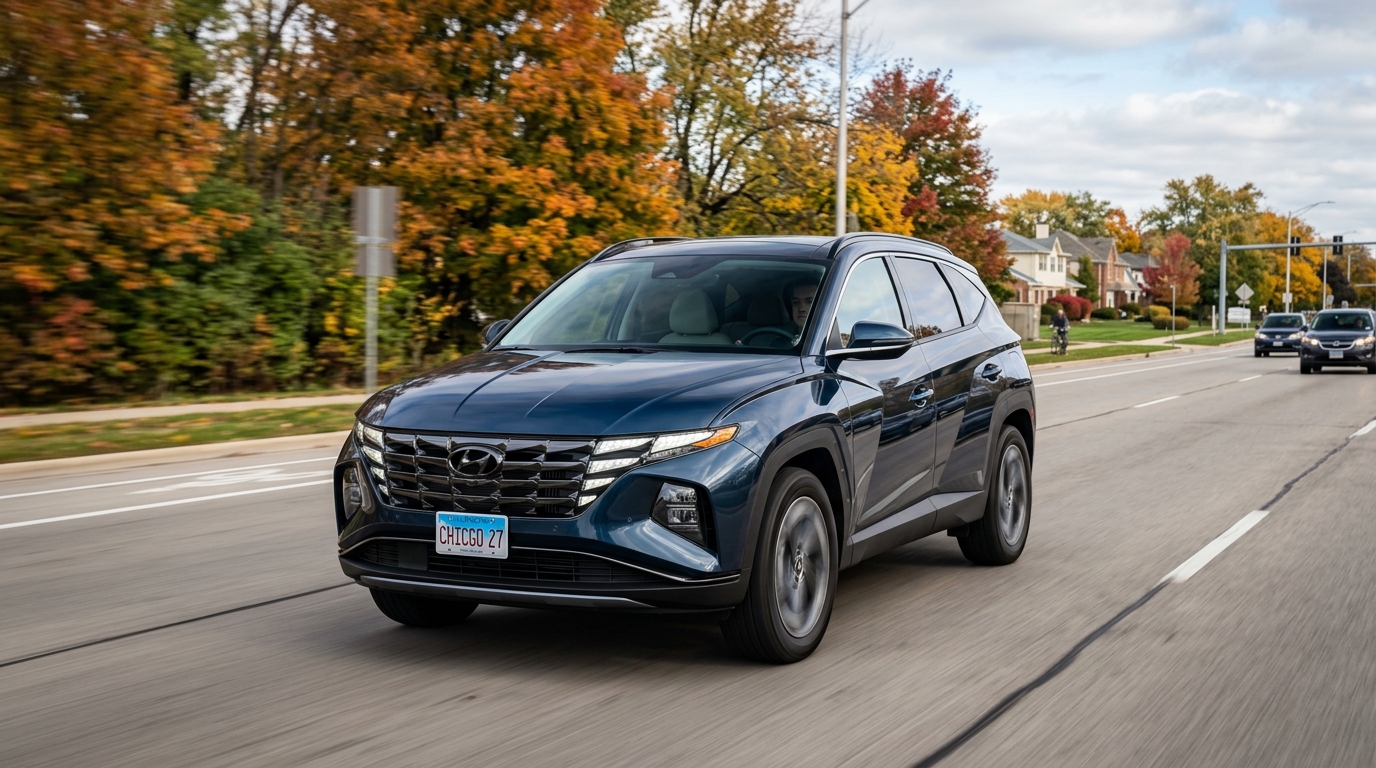
A 2027 Hyundai hybrid is worth buying for commuters seeking substantial fuel savings without sacrificing driving performance or winter traction. Delivering EPA-estimated fuel economy up to 54 mpg combined in sedans like the Elantra Hybrid and up to 38 mpg combined with standard all-wheel drive in crossovers like the Tucson Hybrid, Hyundai's hybrid lineup reduces fuel expenses while offering robust power and extensive warranty protection.
Commuting across the Chicago area demands a vehicle that balances fuel efficiency with cold-weather capability. The 2027 Hyundai hybrid lineup achieves this balance through advanced parallel hybrid architecture that combines turbocharged internal combustion engines with high-torque electric motors. Models like the forthcoming 2027 Hyundai Palisade Hybrid are projected to deliver up to 329 hp and an estimated driving range of up to 619 miles on a single tank, making long highway drives efficient and seamless. For daily drives along I-94 from suburban communities like Lincolnwood, the instant low-end torque from the electric motor provides quick acceleration when merging into heavy expressway traffic.
Beyond day-to-day drivability, long-term economic value makes a Hyundai hybrid a compelling investment. Drivers can get pre-approved by prequalifying online before stepping onto the lot to streamline the purchase process. To evaluate these hybrid powertrains firsthand, shoppers can find our showroom address in Lincolnwood or give our team a quick call to arrange a test drive tailored to their daily driving routine.
Table of Contents
- What Are the Key Differences Between Hyundai Hybrid (HEV) and Plug-In Hybrid (PHEV) Models?
- How Does the Tucson Hybrid Engine, Volume, and Pricing Compare Against Standard Crossovers?
- What MPG and Driving Range Does the Elantra Hybrid Get on Winter Commutes?
- What Should You Include in the Total Cost of Owning a Hyundai Hybrid?
- Where Is Berman Hyundai in Lincolnwood and What Do Local Hybrid Buyers Ask Most?
- Common Questions About Hyundai Hybrids
What Are the Key Differences Between Hyundai Hybrid (HEV) and Plug-In Hybrid (PHEV) Models?
The primary difference between Hyundai hybrid (HEV) and plug-in hybrid (PHEV) models lies in battery capacity and charging requirements. Standard hybrids charge their battery strictly through regenerative braking and engine operation without ever needing to plug in, whereas plug-in hybrids feature a larger high-voltage battery that can be recharged via an external electrical outlet to provide roughly 30 to 33 miles of all-electric driving range before switching to hybrid gas-electric mode.
For drivers comparing electrified powertrains, understanding how each system operates helps determine the ideal fit for daily routines. A standard hybrid—such as the Tucson Hybrid or Elantra Hybrid—uses a self-charging system. Energy normally lost during braking is captured by the electric motor and stored in a compact 1.49 kWh lithium-ion battery. The system automatically alternates between electric power, gasoline power, or a combination of both based on driving speed and throttle demand, maximizing fuel efficiency during stop-and-go city travel.
Plug-in hybrid models—available on crossovers like the Tucson PHEV—bridge the gap between traditional hybrids and full battery-electric vehicles. With a high-capacity traction battery, a PHEV allows commuters with short daily travel distances to complete their trip entirely on electricity. Once the electric charge is depleted, the vehicle seamlessly operates as a conventional hybrid, eliminating range anxiety for longer trips. Drivers interested in comparing standard hybrids against plug-in options can explore options by visiting our Chicago-area showroom or reviewing our current selection of certified pre-owned Hyundai Elantra models to find a powertrain matched to their budget.
How Does the Tucson Hybrid Engine, Volume, and Pricing Compare Against Standard Crossovers?
The Hyundai Tucson Hybrid features a 1.6-liter turbocharged GDI four-cylinder hybrid engine producing 231 hp and 271 lb-ft of torque, delivering significantly more power and interior room than class competitors at a competitive price point. Compared to the non-hybrid Tucson, the hybrid powertrain commands roughly a $3,000 price premium—starting around $32,450 for the Blue SE trim—while increasing combined fuel economy from 26 mpg combined to 38 mpg combined and adding standard HTRAC All-Wheel Drive.
Performance in the Tucson Hybrid stands out because Hyundai pairs its turbocharged engine with a 6-speed automatic transmission rather than a continuously variable transmission (CVT). This setup delivers crisp gear shifts and immediate accelerator response when passing or climbing inclines. Beyond horsepower, the Tucson Hybrid provides superior passenger and cargo dimensions when compared directly against key rivals like the Toyota RAV4 Hybrid.
In cabin space comparisons, the Tucson Hybrid provides about 41 inches of rear legroom compared to 38 inches in the RAV4 Hybrid. For hauling cargo, the Tucson Hybrid yields about 39 cubic feet of cargo space behind the second row and expands to about 75 cubic feet with the rear seats folded flat, beating the RAV4 Hybrid's 70 cubic feet of maximum cargo capacity. Safety remains central to the design, highlighted by standard features like Forward Collision-Avoidance Assist, Blind-Spot Collision Warning, and Rear Cross-Traffic Collision-Avoidance Assist, helping the Tucson Hybrid earn a TOP SAFETY PICK+ rating from the Insurance Institute for Highway Safety (IIHS).
What MPG and Driving Range Does the Elantra Hybrid Get on Winter Commutes?
The Hyundai Elantra Hybrid delivers an EPA-estimated 53 mpg city / 56 mpg highway / 54 mpg combined in its Blue trim, yielding a total driving range of nearly 600 miles on an 11-gallon fuel tank. During harsh sub-zero winter weather, fuel economy typically decreases by 10% to 20% due to cabin heating demands and initial battery warm-up cycles.
For commuters facing dense urban traffic in neighborhoods like West Ridge along busy commercial stretches like Devon Avenue, the Elantra Hybrid maximizes fuel economy through frequent engine shutoffs during idling and coasting. The high-voltage battery powering the hybrid electric motor operates alongside a 1.6-liter four-cylinder gas engine, delivering smooth power distribution. Looking forward, the redesigned 2027 Elantra Hybrid is anticipated to increase system output to roughly 155 hp, enhancing highway merging performance while retaining exceptional efficiency.
A common question among winter drivers is whether to warm up a Hyundai hybrid engine in sub-zero Chicago temperatures. Extended idling is unnecessary and wastes fuel. Driving gently after 30 to 60 seconds helps the internal combustion engine and high-voltage hybrid battery reach optimal operating temperatures faster while preserving fuel. Advanced thermal management systems automatically regulate component temperatures, allowing drivers to hit the road with confidence even in severe cold.
What Should You Include in the Total Cost of Owning a Hyundai Hybrid?
Calculating the total cost of owning a Hyundai hybrid requires accounting for the vehicle purchase price, depreciation, fuel, insurance, vehicle registration, and scheduled routine maintenance. Over a typical five-year ownership period, substantial fuel savings and low maintenance requirements significantly reduce overall operating expenses compared to non-hybrid gasoline vehicles.
Fuel efficiency serves as the primary driver of long-term savings. Driving a hybrid achieving 38 mpg combined or 54 mpg combined drastically cuts monthly fuel bills compared to traditional crossovers averaging 26 mpg combined. Because regenerative braking absorbs much of the stopping force during city driving, wear on brake pads and rotors is reduced, extending brake component lifespan.
Factory warranty protection plays an essential role in capping unexpected repair expenses. Every new Hyundai hybrid is backed by a 5-year/60,000-mile basic warranty and a 10-year/100,000-mile powertrain warranty, which includes dedicated coverage for the high-voltage hybrid battery pack. Additionally, buyers benefit from standard protection programs; shoppers can review our Hyundai Assurance details to understand the full scope of coverage, including complimentary maintenance intervals and manufacturer-backed roadside assistance. To request immediate emergency towing or tire support, drivers can connect directly with Hyundai Roadside Assistance: 1-855-371-9460 for 24/7 manufacturer-backed coverage.
Where Is Berman Hyundai in Lincolnwood and What Do Local Hybrid Buyers Ask Most?
Berman Hyundai is located at 6747 Lincoln Ave, Lincolnwood, IL 60712, providing convenient access for car buyers seeking new, certified pre-owned, and electrified Hyundai vehicles. Our sales team provides transparent pricing, flexible financing options, and knowledgeable guidance on choosing the right hybrid model.
When visiting our dealership, local shoppers frequently ask about real-world winter performance, battery longevity, and trade-in valuations. Our team walks buyers through available trim levels—such as the value-packed Blue SE or feature-rich SEL Convenience—to match specific commuting habits and household budgets. Buyers can use our dealership map link to plan their route to our showroom, or call our vehicle specialists at (847) 582-3294 to confirm current vehicle availability.
Taking the next step toward hybrid ownership is straightforward. Whether you want to evaluate the spacious cabin of a Tucson Hybrid, test drive an efficient Elantra Hybrid, or preview upcoming three-row models like the 2027 Santa Fe Hybrid or Palisade Hybrid, our team is ready to assist. Schedule a test drive today to experience the performance and value of Hyundai hybrid technology firsthand.
Common Questions About Hyundai Hybrids
Q: Does a standard Hyundai hybrid require plugging into an electrical outlet?
No, standard Hyundai hybrid models like the Tucson Hybrid or Elantra Hybrid do not require an electrical outlet or charging station. The high-voltage lithium-ion battery recharges automatically while driving through regenerative braking and energy generated by the gasoline engine. You simply fill the gas tank at any standard gas station.
Q: How does severe cold weather impact high-voltage hybrid battery warranty coverage?
Sub-zero winter temperatures do not alter or restrict Hyundai's factory warranty protection. The high-voltage hybrid battery pack is covered under Hyundai's 10-year/100,000-mile powertrain warranty, protecting against manufacturing defects and premature capacity loss regardless of local seasonal climate conditions.
Q: What documents should I bring when applying for hybrid vehicle financing?
To streamline your credit approval when visiting the showroom, bring a valid driver's license, your two most recent pay stubs or proof of income, proof of residency such as a recent utility bill, and a current auto insurance card. Bringing these documents helps our finance specialists secure competitive loan rates quickly.
Q: What is the expected total driving range on a full tank for the 2027 Palisade Hybrid?
The 2027 Hyundai Palisade Hybrid Blue FWD trim is rated at an EPA-estimated 34 mpg combined ( 33 mpg city / 35 mpg highway), providing an estimated total driving range of up to 619 miles on a single tank of gas. All-wheel-drive models are rated at 30 mpg combined.
Q: Is all-wheel drive standard on Hyundai hybrid SUV models?
Yes, HTRAC All-Wheel Drive is standard equipment on crossover models like the Tucson Hybrid, including the entry-level Blue SE trim. Standard all-wheel drive provides enhanced winter traction and stability without requiring an extra package fee or trim upgrade.