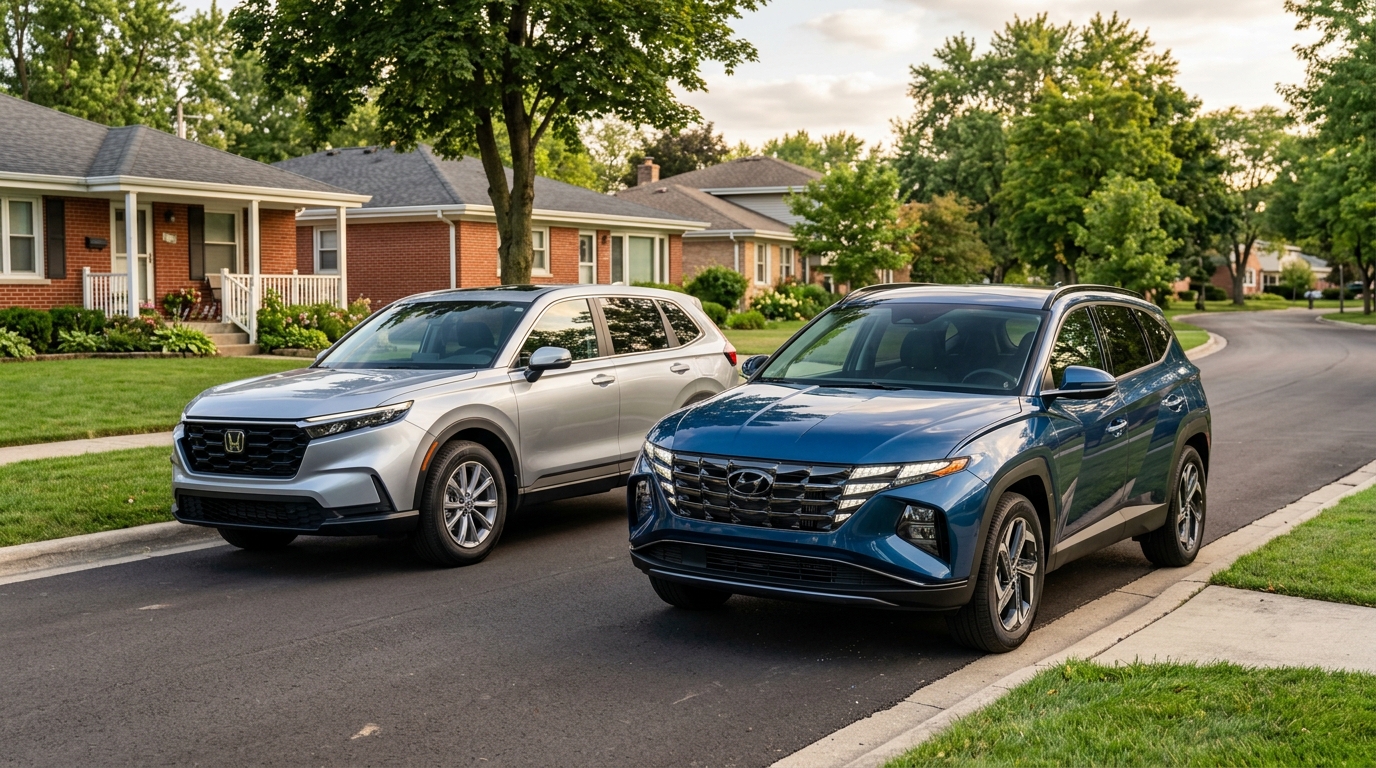
The 2026 Hyundai Tucson overall wins this head-to-head comparison against the 2026 Honda CR-V by delivering superior performance, better fuel efficiency, higher towing capacity, and longer warranty protection. With 231 hp and 38 MPG combined standard on its HEV powertrain, the Tucson outpaces the CR-V in both capability and long-term ownership value.
Table of Contents
- How Pricing and Trim Options Match Family Budgets for the 2026 Hyundai Tucson and 2026 Honda CR-V
- Cargo and Passenger Space Designed for Active Family Lifestyles in the 2026 Hyundai Tucson vs 2026 Honda CR-V
- Powertrains Built for Suburban Commutes: Comparing the 2026 Hyundai Tucson and 2026 Honda CR-V Performance
- Fuel Efficiency and Range for Weekend Getaways: 2026 Hyundai Tucson vs 2026 Honda CR-V
- Connectivity and Safety Features That Support Parents in the 2026 Hyundai Tucson and 2026 Honda CR-V
- Warranty, Maintenance, and Local Service Resources for 2026 Hyundai Tucson and 2026 Honda CR-V Owners
- Common Buyer Questions Comparing the 2026 Hyundai Tucson and 2026 Honda CR-V for Families
- Final Recommendation: Why the 2026 Hyundai Tucson Takes Top Honors
Which SUV Offers the Best Value for Lincolnwood Families: 2026 Hyundai Tucson or 2026 Honda CR-V?
The 2026 Hyundai Tucson provides the better overall value for crossover shoppers, delivering higher horsepower, superior fuel efficiency, and a longer factory warranty package at competitive price points. Starting at an MSRP of $32,450 for the Blue SE HEV AWD (Before May 2026) trim and $32,800 for the standard Blue SE HEV AWD trim, the Tucson comes fully equipped with a standard hybrid powertrain generating 231 hp and 271 lb-ft of torque. In comparison, the entry-level 2026 Honda CR-V EX 2WD carries a higher starting MSRP of $33,150 while providing a non-hybrid 1.5L engine generating only 190 hp and 179 lb-ft of torque.
When evaluating what you get for your initial investment, the Tucson offers standard all-wheel drive on its entry hybrid trim, whereas adding AWD to the base CR-V EX increases its price to $34,650. That represents a significant cost difference before even considering fuel savings over years of daily driving. Families planning routine trips along flat suburban parkways to local spots like Lincolnwood Common Park will find that the Tucson provides robust standard equipment without requiring expensive option packages.
Furthermore, every new Tucson purchased at Berman Hyundai includes peace of mind through the manufacturer coverage suite, which you can learn about by exploring the Hyundai Assurance program. By offering lower entry pricing on standard AWD hybrid configurations alongside industry-leading powertrain protection, the Tucson secures a clear advantage in total financial value.
Pricing
Manufacturer-listed pricing per trim, across compared vehicles.
| 2026 Hyundai Tucson Trim | MSRP | 2026 Honda CR-V Trim | MSRP |
|---|---|---|---|
| Blue SE HEV AWD (Before May 2026) | $32,450 | EX 2WD | $33,150 |
| Blue SE HEV AWD | $32,800 | EX AWD | $34,650 |
| Limited FWD | $39,675 | EX-L 2WD | $35,400 |
| Limited AWD | $41,175 | EX-L AWD | $36,900 |
How Pricing and Trim Options Match Family Budgets for the 2026 Hyundai Tucson and 2026 Honda CR-V
For buyers carefully evaluating trim-by-trim pricing and feature content, the 2026 Hyundai Tucson presents a distinct strategic advantage in the mid-$30,000 range, while the 2026 Honda CR-V reserves its luxury features for higher price tiers. The Tucson lineup spans from the efficient Blue SE HEV AWD at $32,800 MSRP up to the fully appointed Limited AWD trim at $41,175 MSRP (or $39,675 for Limited FWD). Honda structures the CR-V starting at $33,150 for the EX 2WD, reaching $36,900 for the EX-L AWD.
Looking closely at the upper trim spectrum, the Tucson Limited FWD ( $39,675) and Limited AWD ( $41,175) feature a standard 2.5L engine producing 187 hp paired with an 8-speed SHIFTRONIC® automatic transmission. While the CR-V EX-L AWD comes in lower at $36,900, it lacks the advanced luxury items standard on the Tucson Limited, such as a 12.3-inch instrument cluster, a 12.3-inch center touchscreen, and a Bose® 8-speaker audio system with subwoofer.
Destination and delivery fees remain competitive across both brands, with the Tucson carrying a standard delivery charge of $1,650 (or $1,600 on early Blue SE HEV production). When you compare standard equipment tier for tier, Hyundai packages advanced driver conveniences into accessible price brackets rather than forcing buyers into expensive option add-ons.
Dimensions & Capacity
Capacity and dimensions by trim
| Specification | 2026 Hyundai Tucson | 2026 Honda CR-V |
|---|---|---|
| Seating | 5 | 5 |
| Cargo | 38.7 cu ft | 39.3 cu ft |
| Curb weight | 3,719 lbs | 3,497 lbs |
| Towing | 2,000 lbs | 1,500 lbs |
Cargo and Passenger Space Designed for Active Family Lifestyles in the 2026 Hyundai Tucson vs 2026 Honda CR-V
The 2026 Hyundai Tucson delivers a more versatile cabin design for passenger comfort and heavy-duty utility, despite the 2026 Honda CR-V holding a fractional lead in maximum cargo volume behind the front seats. The Tucson provides about 39 cu ft of cargo space behind the second row and expands to about 74.5 cu ft (HEV models) or about 75 cu ft (gas models) with the rear seats folded down. The CR-V offers about 39 cu ft behind the rear seats and expands slightly further, but cargo volume alone does not tell the full practicality story.
Where the Tucson decisively leads is in towing power and payload allowance. The Tucson Limited achieves a maximum towing capacity of 2,000 lbs on hybrid trims and 2,750 lbs on 2.5L gas trims, supported by a published payload rating of up to 1,285 lbs and a curb weight of 3,719 lbs. The Honda CR-V caps its towing capacity at 1,500 lbs across its 1.5L turbocharged trim lineup with a lighter 3,497 lbs curb weight. This 1,250-lb towing deficit means CR-V owners cannot tow heavier utility trailers or recreational equipment.
For passenger space, both crossover vehicles seat 5 occupants comfortably. However, the Tucson prioritizes rear-seat occupant legroom with a generous 41.3 in of legroom in the second row and 41.4 in up front. Combined with 40.1 in of front headroom and 39.5 in of rear headroom, the Tucson easily accommodates child safety seats, growing teenagers, and adult passengers during long road trips.
Engine & Performance
Powertrain specs by trim
| Specification | 2026 Hyundai Tucson | 2026 Honda CR-V |
|---|---|---|
| Transmission | SHIFTRONIC® | CVT |
| Engine | 1.6L | 1.5L |
| Horsepower | 231 hp | 190 hp |
| Torque | 271 lb-ft | 179 lb-ft |
| Drivetrain | All-wheel drive | Front-wheel drive |
Powertrains Built for Suburban Commutes: Comparing the 2026 Hyundai Tucson and 2026 Honda CR-V Performance
If responsive acceleration and confident highway merging are top priorities, the 2026 Hyundai Tucson HEV easily outperforms the 2026 Honda CR-V. The hybrid Tucson pairs a 1.6L turbocharged Smartstream 4-cylinder engine with an electric motor to generate a robust system total of 231 hp and 271 lb-ft of torque. By contrast, the CR-V EX and EX-L rely on a smaller 1.5L turbocharged gas engine making just 190 hp and 179 lb-ft of torque.
The mechanical difference on the road comes down to transmission choice and torque delivery. Hyundai equips the Tucson HEV with a traditional SHIFTRONIC® automatic transmission featuring manual shift mode and floor-mounted or paddle shifters. This setup delivers crisp, gear-driven shifting without the rubber-band engine drone typical of continuously variable transmissions. The CR-V utilizes a CVT (Continuously Variable Transmission) that prioritizes gentle cruising over direct throttle response.
When accelerating from a stop, the Tucson's electric motor contributes an immediate 195 lb-ft of electric torque, providing swift off-the-line launch feel. Additionally, Hyundai’s active all-wheel drive system distributes power effectively across both axles, maintaining composure during wet or icy Midwestern weather conditions.
Fuel Economy
Fuel economy and range by trim
| Specification | 2026 Hyundai Tucson | 2026 Honda CR-V |
|---|---|---|
| MPG | 38 city / 38 hwy / 38 combined | 28 city / 33 hwy / 30 combined |
Fuel Efficiency and Range for Weekend Getaways: 2026 Hyundai Tucson vs 2026 Honda CR-V
The 2026 Hyundai Tucson HEV sets the standard for efficiency in this comparison, achieving an EPA-estimated 38 MPG city / 38 MPG highway / 38 MPG combined on all-wheel-drive hybrid models. The non-hybrid 2026 Honda CR-V EX FWD manages 28 MPG city / 33 MPG highway / 30 MPG combined, dropping further on AWD configurations.
With its 13.7 gal fuel tank capacity, the Tucson Blue SE HEV AWD delivers a total calculated driving range of 521 mi on a single tank of regular 87-octane fuel. This massive cruising range minimizes refueling stops during daily commutes into downtown Chicago or extended multi-state road trips. The gas-powered CR-V EX AWD achieves a estimated range of roughly 400 miles from its 14.0-gallon tank.
Even when comparing conventional gas models, the Tucson Limited FWD delivers a solid 25 MPG city / 33 MPG highway / 28 MPG combined from its 2.5L engine and 14.3 gal fuel tank, offering a calculated range of 400 mi. For buyers focused on maximizing every gallon of fuel, Hyundai’s hybrid engineering delivers a clear performance and range advantage.
Connectivity and Safety Features That Support Parents in the 2026 Hyundai Tucson and 2026 Honda CR-V
Modern parents demand intuitive tech and proactive driver assistance, and the 2026 Hyundai Tucson leads the class with standard high-definition displays and advanced telematics. Every Tucson HEV features a standard 12.3-inch center touchscreen display with wireless Apple CarPlay and wireless Android Auto integration. Lower CR-V trims start with a much smaller 7-inch screen, requiring an upgrade to higher trim levels to obtain a 9-inch touchscreen.
Hyundai also includes 36 months of complimentary telematics services through its connected ecosystem. Drivers can review connected vehicle tech by reading about Bluelink+ features, which enable remote engine starting, door locking/unlocking, vehicle diagnostics, and cabin climate pre conditioning directly from a smartphone.
In safety evaluations, both vehicles earn top marks, but the Tucson packages comprehensive driver assistance standard across all trims. Standard equipment includes:
- Forward Collision-Avoidance Assist (FCA) with junction turning support and pedestrian/cyclist detection
- Lane Keeping Assist and active lane centering
- Blind Spot Detection (BSD) with rear cross-traffic collision avoidance
- 8 airbags including front-seat side airbags and rear side-impact airbags
- IIHS Top Safety Pick Plus status and Euro NCAP 5-star crash test ratings
The Tucson Limited trim goes even further with a Surround View Monitor 360-degree camera system and Navigation-based Smart Cruise Control with Curve Control, giving parents complete awareness around busy school zones and parking areas in Skokie.
Warranty, Maintenance, and Local Service Resources for 2026 Hyundai Tucson and 2026 Honda CR-V Owners
Long-term ownership confidence is where Hyundai dramatically separates itself from Honda. The 2026 Hyundai Tucson is backed by America’s Best Warranty, providing a 5-year / 60,000-mile new vehicle limited warranty and a 10-year / 100,000-mile powertrain limited warranty. Honda offers a standard 3-year / 36,000-mile limited warranty and a 5-year / 60,000-mile powertrain warranty, leaving CR-V owners unprotected years sooner.
Hyundai also provides 5 years / unlimited miles of 24/7 roadside assistance protection, compared to Honda's 3-year / 36,000-mile roadside coverage. If you ever encounter an emergency on the road, manufacturer-backed help is available by contacting Hyundai Roadside Assistance at 1-800-243-7766.
To view local models backed by this coverage, buyers can browse our certified pre-owned Hyundai Tucson inventory or schedule routine oil changes and multi-point inspections at our certified Hyundai service center.
Common Buyer Questions Comparing the 2026 Hyundai Tucson and 2026 Honda CR-V for Families
Q: Is the 2026 Hyundai Tucson worth choosing over the 2026 Honda CR-V?
Yes. The 2026 Hyundai Tucson HEV offers 231 hp, standard all-wheel drive, and 38 MPG combined for a starting MSRP of $32,800, whereas a comparable CR-V EX AWD starts at $34,650 with only 190 hp and lower fuel economy. Combined with a 10-year / 100,000-mile powertrain warranty, the Tucson provides significantly greater long-term financial and performance value.
Q: Which crossover has better towing capability for family outdoor gear?
The 2026 Hyundai Tucson is superior for towing. Gas-powered Tucson models are rated to tow up to 2,750 lbs, and hybrid models tow up to 2,000 lbs. The Honda CR-V is limited to a maximum towing capacity of 1,500 lbs across its 1.5L turbocharged lineup, making the Tucson the better choice for small trailers or recreational equipment.
Q: Does the Hyundai Tucson offer better infotainment technology than the Honda CR-V?
Yes. The Tucson includes a standard 12.3-inch infotainment touchscreen with wireless Apple CarPlay and Android Auto integration, along with a 4.2-inch or available 12.3-inch digital instrument cluster. Base CR-V trims come standard with a smaller 7-inch display screen.
Q: Where can I test drive the 2026 Hyundai Tucson near me?
You can experience the 2026 Hyundai Tucson in person at Berman Hyundai. To plan your visit, find our showroom on Lincoln Ave, give our sales advisors a quick call at (847) 582-3294, or start your buying process early to prequalify for financing online today.
Final Recommendation: Why the 2026 Hyundai Tucson Takes Top Honors
When cross-shopping compact SUVs, the 2026 Hyundai Tucson clear-cut advantages make it the winning choice for modern suburban families. With a higher horsepower hybrid engine ( 231 hp vs. 190 hp), outstanding EPA fuel economy ( 38 MPG combined), greater towing capacity (up to 2,750 lbs), and larger standard digital screens, the Tucson outclasses the Honda CR-V across the most critical ownership metrics. Add in Hyundai’s unbeatable 10-year / 100,000-mile powertrain warranty and lower starting prices on AWD hybrid models, and the Tucson stands tall as the smarter crossover investment.
We invite you to visit Berman Hyundai at 6747 Lincoln Ave, Lincolnwood, IL 60712 to explore our current Tucson lineup firsthand. Experience the comfortable seating, responsive hybrid performance, and quiet ride quality on a test drive today!